
Three visa agents in Canggu offer different advice about the same question.
"Get B211A, extend it six times, you can stay 12 months legal."
"No no, Second Home Visa, five years, way better."
"Just do visa runs every 60 days, everyone does it."
Meanwhile, nobody mentions: Indonesian tax law doesn't care which visa you have. Stay 183 days, you're a tax resident. Progressive rates hit 35%. The Direktorat Jenderal Pajak collected IDR 1.869 trillion ($119 million USD) in back taxes and penalties from foreign taxpayers in 2024 according to their annual report.
Bali's digital nomad population exploded from roughly 15,000 in 2019 to over 60,000 by 2024 (estimates from multiple coworking spaces and visa agents). Canggu rents doubled. Coffee shops full of MacBooks. Coworking memberships sold out.
Tax compliance rate among this population? Effectively zero according to tax advisors operating in Bali.
The gap between visa status and tax obligations is massive. And Indonesian tax authority is slowly closing it.
The Visa Maze Nobody Explains Properly
Indonesia offers multiple visa options. Each solves different problems. None solve taxes.
Tourist Visa on Arrival (VOA)
- 60 days maximum (30 days + 30-day extension)
- IDR 500,000 (~$32)
- Available to 93 countries
- No work authorization
- Can't be converted to other visa types
B211A Business Visa
- Initially 60 days
- Extendable up to 6 times (30 days each)
- Maximum stay: 12 months total
- Requires sponsor (visa agent provides this)
- Cost: $130-180 depending on agent
- Technically requires business purpose
- Most digital nomads use this
Second Home Visa (launched December 2023)
- 5 or 10 year validity
- IDR 14.4 billion ($916,000) investment OR proof of IDR 2 billion annual income (~$127,000)
- Multiple entry
- Stay up to 183 days per entry
- Can be extended for another 183 days per entry
- Designed for wealthy retirees
- Out of reach for typical digital nomads
KITAS (Limited Stay Permit)
- Requires sponsorship from Indonesian company
- Work permit route
- Initially 1-2 years depending on type
- Renewable
- Costs IDR 12-18 million (~$765-1,145) including agent fees
- Provides clearest legal status for working
- Creates immediate tax obligations
What visa agents don't explain: B211A technically prohibits work. Even remote work. The visa says "business visit" - meetings, negotiations, site visits. Not "work from Bali coffee shop for US clients."
Does immigration enforce this? Rarely. Do they know you're working? Probably. But they focus on overstays and illegal work for Indonesian employers.
Until they don't.
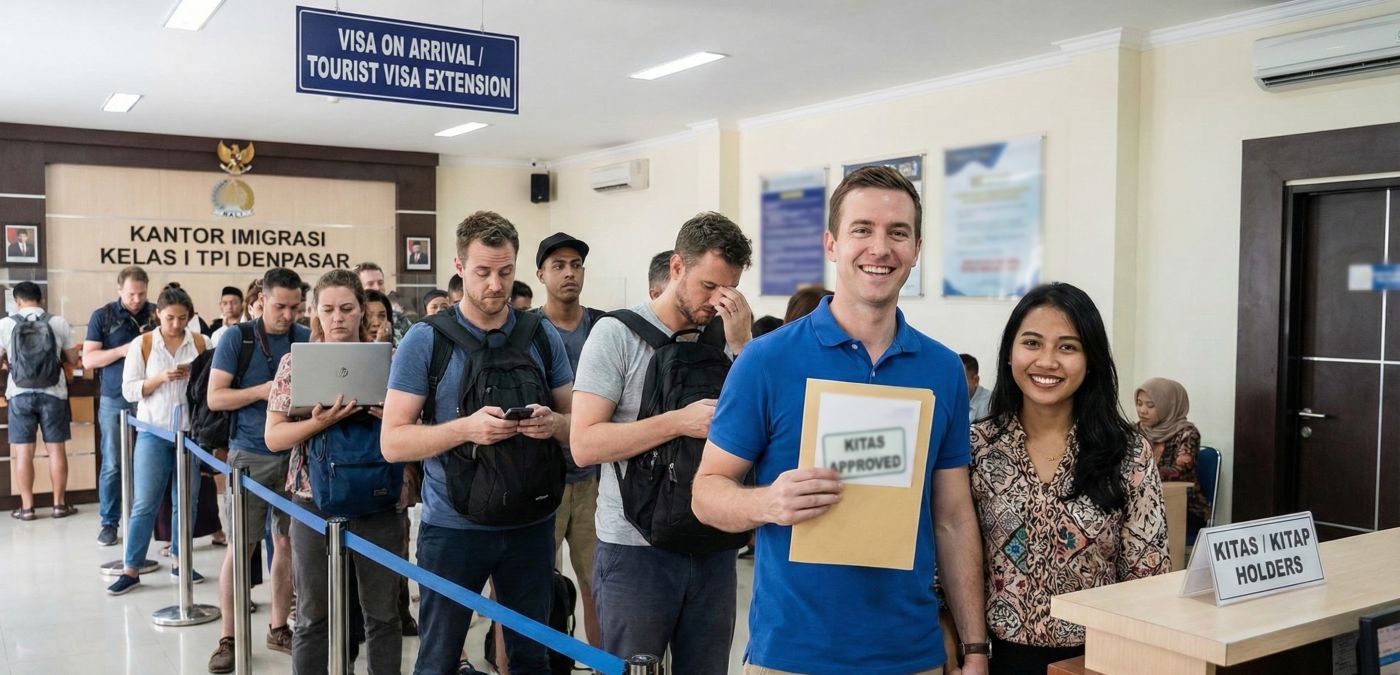
February 2024, immigration raid in Canggu. Checked visas at popular coworking space. Verified people weren't overstaying. Nobody arrested. But message sent: we're watching.
The 183-Day Reality
Indonesian Tax Law (UU No. 7/1983 as amended by UU No. 36/2008) defines tax residency:
You're Indonesian tax resident if ANY of these:
- Stay 183+ days in any 12-month period (not calendar year)
- Live in Indonesia AND intend to reside there permanently
The "intend to reside" part is subjective. DGP (Direktorat Jenderal Pajak) looks at:
- Rental contract length
- Where your family lives
- Bank accounts
- Vehicle ownership
- Business registration
- Social/economic ties
Someone on B211A, extended six times, staying 360 days in Indonesia: Clearly tax resident by the 183-day rule alone.
But even someone doing tourist visa runs can hit problems. Stay 160 days, leave for 2 weeks, return for another 150 days across two calendar years: That's 310 days in a 12-month rolling period. Tax resident.
The calendar year vs rolling 12-months confuses people. DGP can assess either way depending on which puts you over threshold.
What Tax Residency Actually Costs
Tax residents owe Indonesian income tax on worldwide income.
Progressive rates (2025):
- IDR 0-60 million (~$0-3,820): 5%
- IDR 60-250 million (~$3,820-15,920): 15%
- IDR 250-500 million (~$15,920-31,850): 25%
- IDR 500-5 billion (~$31,850-318,500): 30%
- Over IDR 5 billion (over ~$318,500): 35%
Non-tax-treaty personal allowance (PTKP): IDR 54 million annually (~$3,440)
Example: Digital nomad earning $60,000 (IDR 942 million)
Convert to IDR: IDR 942 million Minus PTKP: IDR 888 million taxable
Tax calculation:
- First IDR 60M at 5% = IDR 3 million
- Next IDR 190M at 15% = IDR 28.5 million
- Next IDR 250M at 25% = IDR 62.5 million
- Remaining IDR 388M at 30% = IDR 116.4 million
Total Indonesian tax: IDR 210.4 million (~$13,400) Effective rate: 22.3%
Compare to alternatives:
- Thailand: Was 0% if didn't remit (pre-2024)
- Dubai: 0% personal income tax
- Portugal: Was 20% flat (old NHR)
- Mexico RESICO: 1.5% on this income level
- Vietnam: 18-22% for this income
Indonesia competitive with Vietnam, worse than most other digital nomad destinations.
At $90,000 (IDR 1.413 billion):
Taxable: IDR 1.359 billion
Indonesian tax: IDR 378.7 million (~$24,100) Effective rate: 26.8%
You're hitting that 30% marginal bracket hard.
At $150,000 (IDR 2.355 billion):
Taxable: IDR 2.301 billion
Indonesian tax: IDR 690.3 million (~$44,000)
Effective rate: 29.3%
Approaching the 30% bracket ceiling, but effective rate stays below 30% until you earn substantially more.
The NPWP: The Tax ID You Need But Nobody Gets
NPWP (Nomor Pokok Wajib Pajak) = Indonesian tax identification number.
Required for:
- Opening Indonesian bank account (most banks)
- Buying property
- Buying vehicle
- Filing tax returns
- Various business transactions
Tax residents legally required to obtain NPWP. File for it within 30 days of becoming tax resident or starting income-generating activity.
Process:
- Go to local tax office (KPP - Kantor Pelayanan Pajak)
- Bring passport, KITAS (or visa), proof of address
- Fill out form (mostly in Bahasa Indonesia)
- Receive NPWP card (usually 2-4 weeks)
In practice: Most digital nomads on B211A don't get NPWP. Banks don't always enforce requirement for foreigners. Some accept just passport.
But without NPWP:
- Can't file taxes (even if you want to comply)
- Can't get tax clearance certificate when leaving Indonesia permanently
- Future property purchase complicated
- Converting to KITAS later requires NPWP
The catch-22: Getting NPWP signals to DGP you exist and are earning income. Triggers expectation you'll file returns. Most digital nomads avoid this entire system.
The Banking Situation That Reveals Everything
Indonesian banks report account holder information to DGP. Transaction data available.
Large foreign wire transfers flag automatically. DGP algorithm looks for:
- Regular incoming transfers from abroad
- Amounts suggesting employment or business income
- Pattern consistency (monthly deposits)
- Account holder visa status
If you have NPWP and banking activity but don't file tax returns: Obvious red flag.
If you have banking activity, no NPWP, staying long-term on B211A: DGP can request immigration data, cross-reference, discover you're tax resident.
Current enforcement level: DGP focuses on high-value targets first. Someone with IDR 15 billion in transfers ($955,000) gets attention before someone with IDR 150 million ($9,550).
But the infrastructure exists. Capability improving.
According to Indonesia's Otoritas Jasa Keuangan (OJK - Financial Services Authority), Indonesian banks must implement enhanced due diligence for foreign account holders as of 2024. Includes verification of tax residency status and reporting to DGP.
Many digital nomads use foreign accounts (Wise, Revolut) and avoid Indonesian banking entirely. Reduces but doesn't eliminate risk. Immigration data still shows extended presence.
The Enforcement Reality: Weak Now, Strengthening
DGP collected IDR 1,869.5 trillion ($119 million) in back taxes from foreigners in 2024. Up from IDR 1.2 trillion in 2022. That's 55% increase in two years.
What they're catching:
- Foreign property owners not declaring rental income (biggest focus)
- Expats with KITAS not filing returns
- Business owners with PMA (foreign investment companies)
- High-net-worth individuals with obvious wealth but no tax history
What they're mostly missing:
- Digital nomads on tourist/business visas working remotely
- Freelancers with no Indonesian banking
- People staying under 183 days
- Small-scale remote workers
But: DGP signed OECD Common Reporting Standard. Exchanges financial information with 110+ countries. Implementation improving.
Tax amnesty programs happen periodically. Most recent: Program Pengungkapan Sukarela (PPS) in 2022. Allowed people to declare previously unreported assets and income at reduced penalty rates.
These amnesties reveal two things:
- DGP knows they're missing revenue
- They prefer voluntary compliance to enforcement (less resource-intensive)
But amnesty windows close. Then enforcement follows.
The Penalty Structure
Late filing (past March 31 annual deadline):
- IDR 100,000 (~$6.35) for individuals
- Sounds minimal, but...
Underpayment of taxes:
- 2% per month on unpaid amount
- Compounds
- No maximum cap
Example: Owe IDR 200 million, 6 months late
- Late filing: IDR 100,000
- Monthly penalty: 2% × 6 = 12%
- Penalty amount: IDR 24 million
- Total due: IDR 224.1 million
One year late: 24% additional
False information or tax evasion:
- Administrative penalty: 2-4× the unpaid tax
- Criminal penalty: Prison up to 6 years AND/OR fine up to 4× unpaid tax
DGP takes criminal evasion seriously for amounts over IDR 5 billion (~$318,500). Below that, usually administrative penalties only.
The VAT Surprise
Indonesia has 11% VAT (PPN). Increased from 10% in 2022.
Applies to most goods and services. Digital services too.
If you're providing services to Indonesian clients as a freelancer: Technically should collect and remit VAT if revenue exceeds IDR 4.8 billion annually (~$306,000).
Most digital nomads work for foreign clients, so VAT less relevant. But if you start taking Indonesian clients: VAT obligation kicks in above threshold.
And if you're tax resident earning from Indonesian sources: That income faces both income tax AND potential VAT complications depending on structure.
Double Taxation Treaties
Indonesia has tax treaties with 70+ countries:
- United States ✓
- United Kingdom ✓
- Australia ✓
- Canada ✓
- Germany ✓
- Netherlands ✓
- Singapore ✓
- Many others ✓
These prevent double taxation. Generally:
- If you pay tax in home country, can claim foreign tax credit in Indonesia
- Or pay Indonesian tax, claim credit in home country
- Tie-breaker rules determine primary taxing jurisdiction
But: Must apply for treaty benefits. Not automatic. Requires:
- Certificate of tax residency from home country
- Application to DGP
- Approval process
Form DGT-1 (Domicile Certificate) needed from your home country tax authority.
Most digital nomads don't do this. Either:
- They pay home country taxes, ignore Indonesian obligations (risky)
- They avoid taxes in both places (very risky)
- They structure to stay under 183 days (legitimate if managed properly)
When Indonesia Actually Works
Despite complications, some scenarios win:
Stay under 183 days carefully
Use B211A visa, leave before 183-day threshold. Come back after break, restart count.
Example:
- January-June: 180 days in Bali
- July: Travel Thailand 30 days
- August-December: 150 days in Bali
- Total: 330 days in Indonesia, but never 183 consecutive in 12-month rolling period starting from any arrival
This requires:
- Meticulous day tracking
- Willingness to travel regularly
- Understanding that "12-month period" is rolling window from any point
Tax outcome: Non-resident, only Indonesian-source income taxable. Remote work for foreign clients = IDR 0 Indonesian tax.
Low income under $35,000
After personal allowance and lower brackets, effective Indonesian tax rate: 8-12%
Cost of living in Bali: IDR 15-25 million monthly (~$955-1,590) for comfortable lifestyle.
On $30,000 annual income:
- Indonesian tax: ~IDR 48 million (~$3,060)
- Net after tax: ~$26,940
- Monthly after tax: ~$2,245
This covers living costs with savings. Indonesia wins on cost of living even with tax burden.
Get KITAS, do it properly
For people planning 2+ years in Indonesia and wanting legal clarity:
Find Indonesian company to sponsor KITAS. Or start your own PT PMA (foreign investment company - requires IDR 10 billion capitalization, complex).
Or: Freelancers can get KITAS through Indonesian spouse (if applicable).
With KITAS:
- Legal work status
- Can get NPWP
- File taxes properly
- Access Indonesian healthcare
- Open business bank accounts easily
- Apply for Indonesian driver's license
- Path to permanent residency eventually
Cost: 15-25% effective tax rate at mid incomes, but legal certainty and full integration into Indonesian society.
When Indonesia Doesn't Work
Mid-to-high income focused on tax optimization ($60,000-150,000)
Indonesian effective rates 22-29% at these levels. Not competitive:
- Dubai: 0%
- Old Portugal NHR: 20% flat
- Thailand: Was 0% if managed properly (pre-2024)
- Mexico RESICO: 1.5-2.5%
Unless you specifically love Bali enough to pay 22-29%, better options exist.
Americans with self-employment income
US taxes citizens worldwide. Indonesia taxes residents worldwide.
American digital nomad, tax resident of Indonesia, self-employed earning $80,000:
US side:
- Can use FEIE (Foreign Earned Income Exclusion): Excludes $130,000 (2025)
- Physical presence test: Need 330 days outside US
- But self-employment tax still applies: 15.3% on net
- SE tax on $80,000: ~$12,240
Indonesia side:
- Tax resident (183+ days)
- Indonesian tax on $80,000: ~IDR 252 million (~$16,050)
Treaty allows foreign tax credit. Pay Indonesia tax, claim credit on US return.
But SE tax not eliminated by treaty. That's a separate obligation.
Total taxes:
- Indonesian income tax: $16,050 (creditable against US)
- US SE tax: $12,240 (not creditable)
- Net total: $16,050 + $12,240 = $28,290
Effective rate: 35.4%
Compare to staying in US:
- Federal income tax: ~$11,000
- SE tax: ~$12,240
- Total: ~$23,240
Indonesia costs Americans MORE. Only works if employed (eliminates SE tax) or earning substantially more where FEIE + treaty interaction becomes favorable.
People who can't handle ambiguity
Indonesia's digital nomad situation exists in legal gray zone:
Visa: B211A says no work, but everyone works remotely, rarely enforced Tax: Law clear (183 days = resident), enforcement inconsistent
Banking: Rules tightening, but gaps remain Future: Could tighten significantly or stay loose, nobody knows
For people needing certainty: This is stressful. Portugal, Estonia, Dubai, Colombia all offer clearer paths.
The Bali Reality vs Indonesia Reality
Most digital nomads experience "Indonesia" as "Bali." Specifically Canggu, Seminyak, Ubud, sometimes Uluwatu.
But Indonesian tax law applies nationwide. Same 183-day rule in Bali as in Jakarta, Medan, or Surabaya.
The difference: Enforcement concentration.
DGP offices in Jakarta actively audit foreign businesses and high-value individuals. Sophisticated operation.
DGP office in Denpasar (covers Bali): Less resourced, focuses on obvious cases (property owners, major businesses), struggles with the transient digital nomad population.
Geographic arbitrage within enforcement capacity.
This won't last forever. As Bali's digital nomad population grows and becomes more visible, Denpasar office gets more resources and attention.
2024: DGP opened dedicated foreign taxpayer service center in Denpasar. Specifically to handle increasing expat and digital nomad population. Staff trained in English. Updated systems.
The party's not over. But infrastructure for enforcement being built.
The Second Home Visa Confusion
When Indonesia announced Second Home Visa in December 2023, digital nomad community got excited. "Finally, long-term visa!"
Requirements killed excitement:
- IDR 14.4 billion investment ($916,000) in Indonesian government bonds or property, OR
- Proof of IDR 2 billion annual income (~$127,000)
For context: 2 billion rupiah annual income is 95th+ percentile globally. This isn't aimed at typical digital nomad earning $50,000-80,000.
It's for wealthy retirees from Singapore, Hong Kong, China. Someone selling their apartment in Singapore for $2 million and retiring to Bali. They meet the threshold easily.
Plus: Second Home Visa explicitly limits stay to 183 days per entry (extendable once to 366 days total). The visa literally designed around the tax residency threshold. Stay longer = become tax resident.
This is Indonesia acknowledging the tax issue and building it into visa structure.
Regular digital nomads won't benefit from Second Home Visa. It's not for them.
What $75,000 Actually Costs: The Real Math
Digital nomad, freelance consultant, earning $75,000, considering 12 months in Canggu.
Option A: Stay full 12 months on B211A
Visa costs: $150 (B211A) + $50 × 5 extensions = $400 Living costs: IDR 20 million/month × 12 = IDR 240 million (~$15,285) Total before tax: ~$15,685
Tax status: Resident (365 days) Indonesian tax on $75,000: IDR 262 million (~$16,700) US tax (if American, self-employed): $12,000 SE tax + complications
Total financial burden: $44,385 ($75,000 minus this = $30,615 net)
Effective total tax rate: 40.8% (if American SE)
Legal risk: High (B211A shouldn't be used for work, tax non-compliance)
Option B: Stay 180 days maximum
Visa costs: $150 B211A Living costs: IDR 20 million/month × 6 = IDR 120 million (~$7,640) Time elsewhere: 6 months in Thailand, Mexico, elsewhere (~$10,000)
Tax status: Non-resident in Indonesia Indonesian tax: $0
Home country tax: Depends
Total costs: ~$17,790 living expenses Tax: Home country obligations only
Legal risk: Medium (B211A still technically prohibits work, but 180 days less egregious than 365)
Option C: Get KITAS properly
KITAS costs: IDR 18 million (~$1,145) setup + annual renewal Requires PT PMA: IDR 150-250 million setup (~$9,550-15,920) Ongoing PT PMA costs: IDR 30-50 million annually (~$1,910-3,185) Living costs: IDR 240 million (~$15,285)
Total setup year one: ~$26,950-35,350 before tax
Tax status: Resident (proper legal status) Indonesian tax on $75,000: IDR 262 million (~$16,700)
Total year one: ~$43,650-52,050 Subsequent years: ~$33,900 (living + company + KITAS + tax)
Legal risk: Zero (fully compliant)
The honest calculation: Option B (stay under 183 days) wins financially for someone who can tolerate movement. Option C wins for someone wanting to settle properly. Option A (full year on B211A, no tax filing) is cheapest short-term but riskiest.
The Coming Wave: Golden Visa Speculation
Indonesia discusses various visa reforms constantly. "Golden Visa" appears in government announcements. Digital nomad visas proposed.
Nothing concrete yet. All talk.
But trajectory clear:
- Bali tourism recovering post-COVID
- Digital nomad population growing rapidly
- Tax revenue increasing focus
- Other countries (Thailand, Colombia) creating digital nomad visas
Indonesia will eventually create formal structure. Question is when and at what cost.
Likely outcome: Something similar to Thailand's DTV. Explicit digital nomad visa, moderate cost ($300-500), 1-2 years validity.
Will probably include explicit tax guidance: "183 days = tax resident" written into visa terms.
This clarifies legal status (good) but eliminates current ambiguity that some people exploit (bad for them, good for government).
Time frame: Could be 2025, could be 2027. Indonesian government not known for speed.
Three Real Cases From Bali
Case 1: Australian graphic designer, 274 days in Bali in 2024
Used B211A with six extensions. Loved Ubud. Didn't want to leave.
Never got NPWP. Never filed Indonesian taxes. Earned $67,000 from Australian clients paid to Australian bank account. No Indonesian banking.
No issues yet. But:
- Australian bank reports under CRS to Australian tax office
- Australian tax office shares with Indonesia
- DGP can cross-reference with immigration data
- He's auditable retroactively for 5 years
Risk level: Medium to high. The longer he does this, the worse outcome if caught.
Potential liability if caught: IDR 210 million tax (~$13,370) + penalties (~IDR 42 million) = IDR 252 million (~$16,050)
Case 2: British couple, did visa runs every 89 days
Two visa runs to Singapore in 2024. Stayed Bali 267 days total that year, but never more than 89 consecutive.
Thought they avoided tax residency. Wrong.
Rolling 12-month period from first arrival: 267 days well over 183.
They filed UK taxes, paid UK income tax. Assumed that was sufficient.
Technically Indonesian tax residents, didn't file Indonesian returns.
DGP sent inquiry letter March 2025. Traced through UK-Indonesia information exchange.
Tax owed on £95,000 combined income: IDR 437 million (~$27,830)
Hired Jakarta tax lawyer: IDR 45 million (~$2,865). Filed late returns. Paid taxes and penalties: IDR 485 million total (~$30,895).
Now they stay 182 days maximum and track meticulously.
Case 3: American developer, did it right from start
Earned $110,000 remotely for US tech company. Wanted to live in Canggu long-term.
Researched thoroughly. Options:
- B211A + no compliance = risky
- Stay under 183 days = limits lifestyle
- Get KITAS properly = expensive but clean
Chose: Found Indonesian girlfriend, got serious, got KITAS through relationship sponsorship (KITAS for social/cultural purposes, Article 52).
Cost: IDR 15 million KITAS (~$955) vs IDR 150 million PT PMA setup.
Got NPWP. Files Indonesian taxes annually.
Indonesian tax on $110,000: IDR 428 million (~$27,260) US tax: Used FEIE, no federal income tax, no SE tax (employed, not self-employed)
Total tax: $27,260 Effective rate: 24.8%
Higher than Dubai (0%), but he has:
- Legal status
- Indonesian driver's license
- Full access to healthcare
- Can stay indefinitely
- Girlfriend happy (not constantly visa running)
- Sleeps well
For him: Worth it. He plans 5+ years, maybe permanent. Legal certainty worth the tax cost.
The Honest Assessment
Indonesia's visa situation for digital nomads: messy. Tax situation: clear in law, unclear in enforcement.
The 183-day rule isn't ambiguous. Progressive rates up to 35% aren't hidden. NPWP requirement isn't secret.
What's ambiguous: Whether anyone enforces this on tourist/business visa digital nomads working remotely.
Currently: Mostly not enforced. DGP focuses on bigger fish.
Trajectory: Enforcement improving. Information sharing increasing. The infrastructure being built to catch people retroactively.
Indonesia works if:
- You stay under 183 days (track carefully)
- You earn under $35,000 (rates favorable at lower income)
- You get KITAS and file properly (willing to pay 20-28% for legal clarity)
- You specifically love Bali/Indonesia enough to pay the tax (it's a lifestyle choice, not optimization)
Indonesia doesn't work if:
- Pure tax optimization is goal (better options exist)
- You're American with self-employment income (double burden)
- You earn $60,000-150,000 and want competitive rates
- You need certainty and hate gray zones
The B211A visa everyone uses: convenient, cheap, technically illegal for work purposes. The 183-day tax threshold: easy to hit, hard to avoid if actually living there.
The gap between legal theory and enforcement practice is wide. That gap is closing slowly. Whether you're caught in it when it closes depends on timing and luck.
Count your days. Or get KITAS. Or stay 182 days and leave. Those are the three options that make sense.
Everything else is gambling.
Key Facts:
- Tax residency: 183+ days in any 12-month period (rolling)
- Progressive rates: 5% → 15% → 25% → 30% → 35%
- Personal allowance: IDR 54 million (~$3,440)
- B211A visa: Max 12 months, costs ~$130-180, technically no work allowed
- KITAS: Requires sponsorship, ~IDR 15-18 million (~$955-1,145)
- Second Home Visa: Requires IDR 2 billion income (~$127,000) or IDR 14.4 billion investment (~$916,000)
- NPWP required for tax filing
- Filing deadline: March 31 annually
- Late filing penalty: IDR 100,000 + 2% monthly on unpaid tax
- DGP collected IDR 1,869.5 trillion ($119M) from foreigners in 2024
- Tax treaties with 70+ countries
- Exchange rate: ~IDR 15,700 = $1 USD
Resources:
- DGP (Direktorat Jenderal Pajak): pajak.go.id
- Immigration: imigrasi.go.id
- Tax law: UU No. 36/2008 (Income Tax Law)
- NPWP application: ereg.pajak.go.id
- Visa information: Multiple agents in Bali (verify legitimacy)
⚠️ Important Note: Indonesian tax law is clear: 183+ days makes you a tax resident with worldwide income taxation obligations. The "12-month period" is a rolling window from any arrival date, not just calendar year.
B211A visa technically prohibits work, including remote work. Enforcement currently focuses elsewhere, but this is not legal authorization to work.
This article reflects Indonesian tax law as of late 2025 based on UU No. 36/2008 and DGP guidance. Enforcement practices vary significantly between Jakarta and Bali, and between high-value targets and typical digital nomads.
DGP's participation in Common Reporting Standard means financial account information is being exchanged with 110+ countries. The infrastructure for enforcement is being built even if not yet fully utilized.
Before spending extended time in Indonesia, verify current visa regulations directly with Indonesian immigration (imigrasi.go.id) and consult with licensed Indonesian tax advisors who understand expat situations.
Use this guide to understand the landscape—not as a plan to avoid obligations. The cost of being wrong can be 5+ years of back taxes plus penalties, totaling hundreds of millions of rupiah.